Why Certification Exists
Canada's home water treatment market is largely self-regulated. A filter box can say "removes 99% of contaminants" or "pharmaceutical-grade purification" without any third party checking what was tested, how, or against which standard.
CIWQE Certification is an independent educational designation. It helps Canadians tell the difference between verified performance and marketing language. It is not a government endorsement, and it does not replace recognized standards such as NSF/ANSI. It builds on them and makes the results readable for consumers.
The Eight-Step Evaluation Process
- Product submission. The manufacturer submits product documentation, specifications, performance claims and material safety data.
- Documentation review. Our technical team reviews the submission against Canadian water quality standards, NSF/ANSI frameworks and Health Canada guidelines.
- Laboratory testing. Products are tested at accredited Canadian laboratories under standardized protocols for contaminant reduction and performance.
- Performance verification. Test results are compared with the manufacturer's claims, and any gap between marketing and measured performance is flagged.
- Standards comparison. Results are benchmarked against Health Canada's Guidelines for Canadian Drinking Water Quality and recognized international standards.
- Educational review. We check that the product's documentation is accessible, transparent and free of misleading claims.
- Certification approval. Products that meet every criterion are certified, with public documentation of what was tested, the method used and the results.
- Ongoing compliance. Certification is not permanent. Products are re-evaluated on a schedule, and changes to materials, design or claims trigger a new review.
What Gets Tested
Depending on the system type, evaluation covers:
| Category | What we verify |
|---|---|
| Contaminant reduction | Target contaminants reduced to or below Health Canada guidelines |
| Heavy metals | Reduction of lead, mercury, cadmium, chromium and other regulated metals |
| PFAS | Measurable reduction of per- and polyfluoroalkyl substances |
| Chlorine, taste and odour | Reduction of chlorine, chloramines and aesthetic contaminants |
| Microbial | Pathogen reduction, for systems that claim it |
| Material safety | Nothing in contact with water leaches harmful substances |
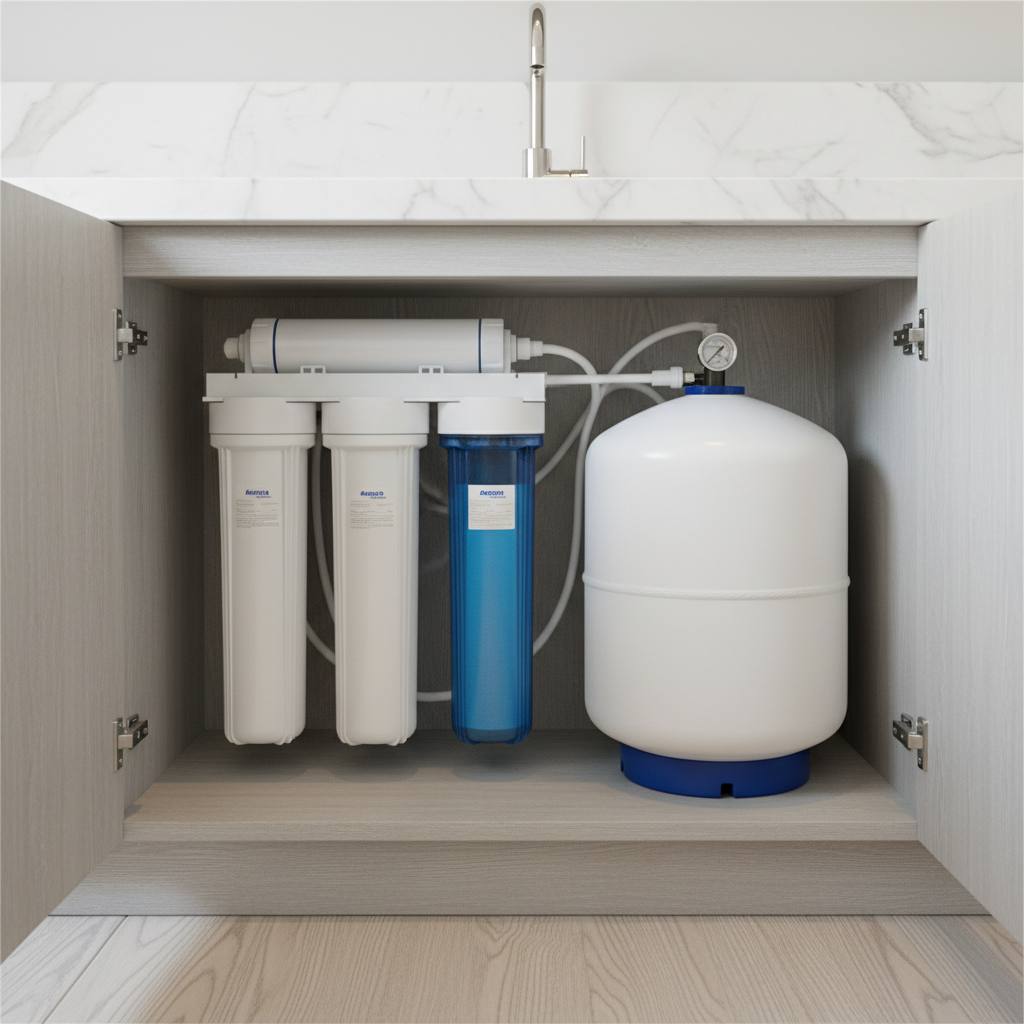
| Structural integrity | Housings, seals and membranes hold up at normal operating pressures |
| Flow rate | Adequate flow without losing filtration performance |
| Long-term reliability | Performance holds across the full rated life of the filter media |
For lead, for example, challenge water is prepared at 0.15 mg/L, thirty times Health Canada's limit of 0.005 mg/L, and the treated water is analyzed by ICP-MS at an accredited lab across the filter's full rated life.
Certification Levels
| Level | Who it's for | Key requirements |
|---|---|---|
| CIWQE Certified (Foundation) | Systems meeting baseline performance | ≥95% reduction of rated substances, material safety, public documentation, retesting every 24 months |
| Advanced Reduction Certified | Systems with an expanded contaminant profile | Foundation requirements plus ≥12 contaminant categories, VOC reduction per NSF/ANSI 53, heavy-metal panel |
| PFAS Reduction Verified | Systems making PFAS claims | PFOA + PFOS reduction ≥90%, minimum 6-compound panel, EPA Method 533 or 537.1, annual re-evaluation |
| Whole Home Performance Certified | Point-of-entry systems | Flow ≥8 L/min, chlorine reduction across full media life, 10+ year lifespan test |
| Drinking Water Purification Certified | Comprehensive multi-stage systems | Advanced requirements plus ≥4-log (99.99%) microbial reduction, ≥95% TDS reduction for RO, annual independent lab testing |
| Sustainability Recognition | Systems with lower environmental impact | Published wastewater ratio, filter life ≥6 months at rated capacity, packaging and recyclability review |
How to Read Any Certification Claim
Whether a product carries CIWQE, NSF/ANSI or another mark, ask four questions:
- Which contaminants? A certification covers specific substances, not "everything."
- Which standard or method? Look for a named standard, such as NSF/ANSI 53 or 58, or a named lab method.
- At what capacity? Performance is tested to a rated number of litres. Past that, claims no longer apply.
- Is the report public? Real testing produces a document you can read.
Then match the product to your water. Test first, so you know what you actually need to remove. Our Lab Directory and water quality lookup are good places to start.
Questions About Certification
Manufacturers and consumers can reach us through our contact page. Full criteria are on our Certifications page.
Educational Content Notice
This article is provided for general educational purposes only. The Canadian Institute for Water Quality Education does not endorse specific commercial products or services. Always consult a certified water professional for advice specific to your situation.